

Love
Title: True Fruit: Reclaiming God's Definition of Love in a Counterfeit Culture Sermon Summary: This sermon opens a new series called "True Fruit," which examines how contemporary culture has redefined biblical words — particularly the fruits of the Spirit listed in Galatians 5 — to suit human desires rather than God's design. The pastor argues that using biblical vocabulary with non-biblical definitions leads people to pursue the wrong destinations in life, relationships, and faith. Focusing on love as the first fruit in the series, the sermon draws primarily from John 15 to establish that true love has a divine source, a Christ-centered standard, and a sacrificial nature. The pastor emphasizes that genuine, transformative love is not a human-generated emotion or cultural sentiment but a Spirit-produced commitment to pursue what God says is good for another person, even at personal cost. The cross of Jesus Christ is presented as the ultimate and definitive picture of what love truly is. Key Points: Our culture borrows biblical vocabulary but redefines words like love, joy, peace, and freedom to center on personal satisfaction rather than God's design, leading people to pursue wrong destinations with sincere effort True love originates not in human personality or emotion but in God alone, flowing from the Father through the Son to believers and then outward to others, meaning one must first receive God's love through salvation before being capable of truly loving others The standard for love is not how someone makes us feel or whether they deserve it, but the example of Christ himself, who loved without conditions Love and truth are inseparable; truth without tenderness can become brutality, but tenderness without truth can become cowardice True love is sacrificial by nature, costing time, convenience, comfort, pride, and resources, with the cross of Christ standing as the definitive act and definition of love In marriage specifically, the biblical model calls husbands to love as Christ loved the church and wives to submit as unto the Lord, meaning both are first called to submit to Jesus rather than demanding from each other Spouses, children, friends, and church cannot be treated as a savior; Jesus Christ alone is the source of the love the soul needs Scripture Reference: Galatians 5:16-17 and 5:22-23, which contrast the desires of the flesh with the fruit of the Spirit John 15:9, 12-13, in which Jesus commands his disciples to love one another as he has loved them and defines the greatest love as laying down one's life for a friend 1 John 4:19, which states that believers love because God first loved them Ephesians 5:22 and 5:25, addressing the mutual obligations of husbands and wives modeled after Christ and the church Romans 5:8, which declares that God demonstrated his love by sending Christ to die for us while we were still sinners Philippians 2:5-8, describing Christ humbling himself from the form of God to the form of a servant, becoming obedient even to death on a cross 2 Corinthians 4:18, referenced in the opening, noting that the things which are seen are temporary John 10:27-28, the basis for the congregation's weekly declaration to hear, obey, and live in peace
Joy
Title: True Joy: Finding What the World Cannot Give and Cannot Take Away Sermon Summary: In this second installment of the series "True Fruit: God's Truth in a Counterfeit Culture," the pastor examines the fruit of joy as described in Galatians 5:22, challenging the congregation to reject the culture's redefinition of joy as circumstantial happiness and embrace the biblical reality of joy as a permanent, Christ-centered possession. Drawing primarily from Philippians 4:4-13, the sermon establishes that true joy is not a fluctuating emotion tied to favorable circumstances but a settled conviction rooted in the unchanging person of Jesus Christ. The pastor argues that as children of God, believers already possess all the joy God can give through the indwelling Holy Spirit, and that the key to experiencing that joy lies in identifying its source, renewing the mind, and learning contentment through Christ's strength. The sermon closes with a practical seven-day challenge calling believers to prioritize God's Word before engaging with media each morning. Key Points: Joy and happiness are not the same thing; happiness is circumstantial and temporary while true biblical joy is eternal and unchanging As children of God, believers already possess all the joy God can give; the problem is not a lack of joy but a misidentification of happiness as joy True joy has a source, and that source is exclusively the person of Jesus Christ, who does not change regardless of circumstances True joy requires a renewed mind, which means believers must discipline their attention spans and be intentional about what occupies their thoughts The modern media environment, particularly features like infinite scroll, is engineered to consume attention with negativity and outrage, which directly undermines the experience of true joy True joy learns contentment, as Paul demonstrated by rejoicing equally in abundance and in need Attaching conditions to joy -- waiting for circumstances to improve before allowing oneself to rejoice -- is a spiritual danger that keeps believers perpetually chasing what they already possess in Christ Scripture Reference: Galatians 5:22 (the fruit of the Spirit, with focus on joy) Philippians 4:4-13 (primary text: rejoicing always, a renewed mind, and contentment through Christ) 1 Thessalonians 5:16-18 (rejoice always, pray continually, give thanks in all circumstances) Romans 15:13 (the God of hope filling believers with all joy) John 16:22 (no one will take your joy from you) Philippians 1:6 (God completing the good work he began in believers) Romans 8:28 (all things working together for good) Genesis 50:20 (Joseph declaring that what was meant for evil, God meant for good)

Peace
Title: True Peace: A Spirit-Given Assurance in the Midst of Life's Storms Sermon Summary: In this message, part of an ongoing series titled "True Fruit: God's Truth in a Counterfeit Culture," the pastor examines what true, biblical peace actually means in contrast to how the surrounding culture defines it. While the world defines peace as the absence of conflict, uncertainty, or difficulty, Jesus offers a peace that is rooted not in external circumstances but in His own person and presence. Drawing from John 14:27, the pastor argues that true peace is a Spirit-given assurance that God is in control even when life feels out of control. This peace is not manufactured by human effort, positive thinking, or environmental change, but is the direct result of a transformed heart through a personal relationship with Jesus Christ. The Holy Spirit, dwelling within believers, provides a divine, abiding peace that surpasses human understanding and confronts fear rather than avoiding it. Key Points: The culture defines peace as how one feels when everything around them settles down, but this definition leaves people perpetually searching without finding True peace comes from a person, Jesus Christ, not from favorable circumstances Jesus offers peace not by removing the storm but by being present within the storm The Holy Spirit, given to believers at salvation, is the agent who produces and sustains this peace internally True peace is different from the world's peace because it remains even when external conditions refuse to cooperate True peace confronts fear rather than avoiding it; obedience sometimes creates difficult moments, and God's peace gives strength to enter them Avoiding difficult conversations or situations is not the same as possessing biblical peace Believers are never alone in their trials, not for even a single moment The prescription for peace involves daily rehearsing truths about God: He is present, He knows, He sees, He is faithful, He is sovereign, and He has an eternal plan Scripture Reference: John 14:25-27, in which Jesus promises His peace to His disciples, distinguishing it from the peace the world offers and commanding them not to let their hearts be troubled or afraid Philippians 4:7, which describes the peace of God as surpassing all human understanding, guarding the hearts and minds of believers Ezekiel 36:26, in which God promises to give His people a new heart and a new spirit John 10:27, in which Jesus describes His sheep as those who hear His voice and follow Him

Patience
Title: True Patience: Trusting God's Timing When Waiting Is Hard Sermon Summary: This sermon is part of a series titled "God's True Fruit: God's Truth in a Counterfeit Culture," working through the fruits of the Spirit found in Galatians 5:22-23. The pastor focuses on patience as the fourth fruit, arguing that the modern culture of instant gratification has dangerously shaped how believers approach waiting on God. True patience, as defined by Scripture, is not passive resignation or endless frustration, but an active, Spirit-produced trust in God's character and timing. Drawing from James 5:7-11, the sermon challenges believers to stop measuring God's faithfulness by their own self-imposed deadlines and instead allow the waiting process to deepen their faith, refine their character, and transform how they treat others. The sermon concludes with a call to surrender unanswered prayers back to God and trust that He is always working, even when His work is not yet visible. Key Points: True patience waits for God to work, just as a farmer cannot rush a harvest but must trust the growth process beneath the surface True patience changes us while we wait, establishing and strengthening our hearts rather than simply passing time until circumstances change God's delays are not necessarily God's denials, and waiting on the Lord is an active recharging of faith rather than wasted time True patience changes how we treat the people around us, as impatience in circumstances almost always spills over into relationships with those we love most True patience trusts God's character when His timing cannot be understood, anchoring in the truth that God is compassionate and merciful even when answers are unclear The fruits of the Spirit are organized in three outward directions: upward toward God (love, joy, peace), outward toward others (patience, kindness, goodness), and inward in character (faithfulness, gentleness, self-control) The seven-day practical challenge encourages believers to pause ten seconds before reacting in impatience, pray "God, grow me while I wait," and ask "What would the fruit of patience look like right now?" Scripture Reference: James 5:7-11, the primary text, where James calls suffering believers to patient endurance modeled after the farmer, the prophets, and Job Galatians 5:22-23, the series foundation describing the nine fruits of the Spirit Philippians 1:6, which affirms that God who began a good work will bring it to completion Isaiah 40:31, which promises renewed strength for those who wait on the Lord 1 Corinthians 11:27-29, used during the Lord's Supper to call believers to self-examination before partaking 1 John 1:9, cited as the promise of immediate and complete forgiveness upon confession of sin

Kindness
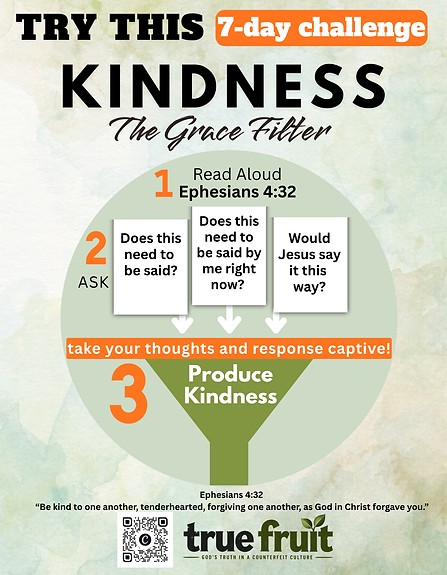
Title: True Kindness: Extending Grace in a Culture of Niceness Sermon Summary: This sermon, part of a series called "True Fruit: God's Truth in a Counterfeit Culture," examines the biblical definition of kindness as distinct from the world's watered-down version of mere niceness. Drawing primarily from Ephesians 4:25-32, the pastor argues that true kindness is not simply avoiding conflict or being pleasant, but rather actively extending to others the same grace God has extended to us through Christ. The sermon identifies three key indicators of true kindness: it changes our words, it changes our reactions, and it is rooted in a remembrance of God's grace toward us. Throughout, the pastor challenges believers to filter their speech and responses through the gospel, recognizing that the forgiveness God offered us while we were still sinners is the ultimate standard and motivation for how we treat others. Key Points: Biblical kindness is fundamentally different from cultural niceness, which smiles while avoiding truth and can allow people to walk toward destruction without intervention True kindness changes our words by ensuring that speech builds others up and gives grace rather than tearing down what God is trying to build Not every true statement needs to be spoken immediately; timing, tone, and intent all matter in kind communication True kindness changes our reactions by addressing the underlying attitudes of bitterness, wrath, anger, clamor, slander, and malice before they corrupt our responses Technology has removed the natural pauses that once allowed the Holy Spirit to intervene before harmful words were sent Biblical confrontation seeks restoration, not humiliation, and is done in a spirit of gentleness True kindness is rooted in remembering grace, specifically that God pursued us and forgave us while we were still sinners Forgiveness does not mean pretending a wound never happened or abandoning healthy boundaries, but grace always moves toward restoration Believers should take every thought captive before responding, asking whether a response needs to be said, whether it needs to be said by them right now, and whether Jesus would say it that way Scripture Reference: Ephesians 4:25-32 (primary passage on speech, attitudes, and grace-filled kindness) Galatians 5:22-23 (the fruit of the Spirit, series foundation) Proverbs 18:21 (the power of life and death in the tongue) John 1:14 (Jesus being full of grace and truth) James 1:19-20 (being quick to hear, slow to speak, slow to anger) 2 Corinthians 10:5 (taking every thought captive to obedience to Christ) Romans 5:8 (God demonstrating love toward us while we were still sinners) Galatians 6:1 (restoring those caught in sin with a spirit of gentleness)
Goodness
Title: True Goodness: Surrendering to God's Definition in a Counterfeit Culture Sermon Summary: This sermon, part of a series called "True Fruit: God's Truth in a Counterfeit Culture," examines the biblical meaning of goodness as a fruit of the Spirit. The pastor distinguishes goodness from kindness, explaining that while kindness describes how we treat people, goodness describes a commitment to do what God says is right. Drawing primarily from Romans 12:1-2 and 9-21, the sermon challenges the congregation to reject culturally redefined notions of goodness and instead surrender to God's authority as the sole definer of what is truly good. The pastor argues that true goodness is not produced by personal sincerity or popular consensus, but by spiritual transformation through the Holy Spirit, the Word of God, and surrender of one's own will. The sermon calls believers to allow God to define goodness rather than seeking His approval for self-made definitions. Key Points: Kindness and goodness are related but distinct: kindness describes how we treat others, while goodness describes commitment to what God declares is right True goodness is a Spirit-produced character that recognizes what God says is right and chooses to do it When goodness is defined by culture or self, the standard is always shifting and subjective, making it unreliable as a moral foundation America is experiencing a moral revolution in which embracing a new cultural morality is celebrated while holding to traditional moral standards is increasingly condemned True goodness begins with surrender, as described in Romans 12:1, where believers are called to present themselves as living sacrifices Negotiating with God over the terms of obedience is not surrender but self-will dressed in religious language True goodness requires transformation of the mind, as described in Romans 12:2, which begins with a relationship with Jesus Christ and the indwelling Holy Spirit The Holy Spirit uses the Word of God to transform the child of God, recalibrating thinking and guiding practical decisions from Monday through Saturday God alone has the authority to define what is good, and that definition is rooted in His will, not human preference or cultural consensus The human heart is creative in renaming sin to gain permission for it, such as calling bitterness boundaries, gossip concern, or cowardice keeping the peace Romans 12:9-21 shows goodness lived out practically through sincere love, abhorring evil, honoring others, and speaking hard truth A spiritually healthy person does not ask God to approve their definitions but allows God to transform them Scripture Reference: Romans 12:1-2 and 9-21, which serve as the primary text, addressing surrender, transformation, and the practical outworking of goodness 2 Corinthians 4:18, the congregation's memory verse, which speaks of focusing on what is eternal rather than what is temporary John 17:17, referenced regarding sanctification through God's Word as truth Colossians 1:17, cited in the context of Christ holding all things together, including humanity's future Matthew 24:36, referenced to affirm that God alone knows the timing of the end 1 Corinthians 2:14, cited to explain that spiritual things are spiritually discerned and require transformation, not merely information John 16:13, referenced regarding the Holy Spirit guiding believers into all truth Isaiah 48:20, referenced as the scriptural basis for a song sung during worship
